Floating cities represent a new frontier in urban development. By providing climate-resilient, adaptable space on water, they offer innovative solutions to growing urban pressures. But successful floating infrastructure requires more than engineering – it requires a deep understanding of the marine ecosystem where our neighborhoods will float.
At SquareFloatingCity, environmental monitoring is a cornerstone of our approach, guiding both design and operation to ensure our platforms coexist harmoniously with marine life.
The importance of environmental monitoring
Our floating CityBlocks interact with their surroundings in multiple ways: they alter currents, shade aquatic habitats, and provide new surfaces for organisms to colonize. To manage these effects responsibly, environmental monitoring is essential, both before installation and during operation.
Baseline monitoring establishes a detailed picture of the local ecosystem. Key elements include:
- Water quality and chemistry
- Biodiversity and habitat mapping
- Sediment characteristics
- Flow dynamics and light conditions
By collecting this information early, developers can anticipate potential ecological impacts and design floating structures that minimize disturbance and support natural habitats. This also allows to adjust design to local conditions, as a lot of impacts will depend on each location’s characteristics.
Designing with nature
Environmental monitoring also informs the actual site and design decisions. Our CityBlocks can create opportunities and threats for marine life: shaded areas may encourage certain species, and submerged surfaces can serve as new habitats for invertebrates and filter feeders, but reduced light, altered water flow, and noise or pollution can also disrupt local ecosystems and harm sensitive species.
Continuous data allows designers to adapt features such as moorings, platform layout, and underwater surfaces to benefit both infrastructure and ecosystems.
Monitoring also ensures operational safety, helping to identify risks such as algal blooms, sudden changes in oxygen levels, or the effects of storms and currents. This data supports proactive maintenance and reduces ecological stress.
Close collaboration with monitoring partners
We now work closely with Indymo, a specialist in aquatic drone-based research and environmental data collection. Their expertise supports our broader environmental assessment strategy and provides detailed insights into underwater conditions around floating platforms.
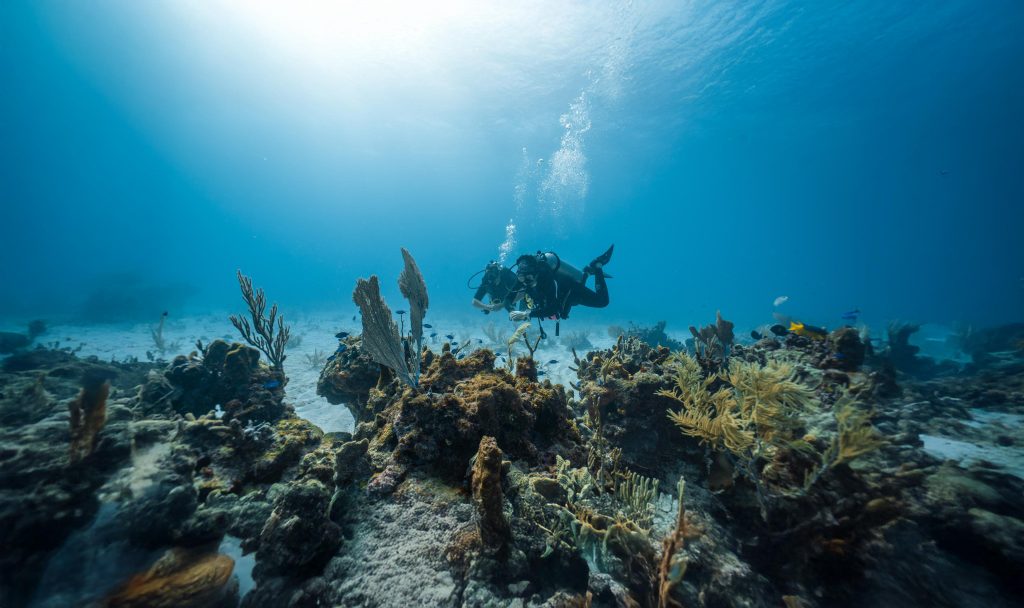
Through these kind of partnerships and knowledge, we are able to characterize the underwater ecosystem, benthic species and aquatic vegetation:
- Conduct underwater surveys using remotely operated vehicles (ROVs)
- Map water quality across different depths and seasons
- Observe biodiversity and track habitat development around the structure
- Analyze sediment composition and bathymetry
- Collect targeted water samples for laboratory analysis
By integrating monitoring findings into our site-specific design, we ensure that the SquareFloatingCity continues to align with the dynamics of the surrounding marine environment.
Supporting a regenerative marine ecosystem
Our goal is not only to minimize impact, but to create positive ecological outcomes. Insights from environmental monitoring help us to:
- Foster new habitats beneath and around the platform
- Enhance biodiversity through targeted design
- Maintain optimal water quality
- Support ongoing ecological research
Lessons from floating projects worldwide, including those in the Netherlands, demonstrate that well-monitored platforms can support thriving underwater communities and could potentially improve local ecosystems over time. For case specific examples, see check out the website of Floating Floating, where both our partners Blue Revolution Foundation and Indymo are part of and support ecological research into large scale floating urbanism.
A long-term commitment
Environmental monitoring is a continuous process. From baseline assessments to long-term operational tracking, it guides every stage of our floating projects. By combining technology, data-driven insights, and ecological expertise from partners like Indymo, we aim to demonstrate that floating urban infrastructure can be both innovative and environmentally responsible.
A key question that guides our work and that of our sister company Blue21 Consulting is how floating structures can support the revitalization of degraded marine areas. Many coastal environments suffer from past disturbance, habitat loss, or pollution.
Additionally floating platforms – which do not require complete seabed destruction – offer new possibilities for ecological recovery. The shaded zones, underwater surfaces to attach to, and controlled hydrodynamic conditions they create can help promote the return of marine species and stabilize local ecosystems.
In this sense, floating development can be a nature friendly alternative to land reclamation. Whereas land reclamation replaces natural seabed with artificial fill, floating structures adapt to existing ecological conditions. This preserves benthic habitats, reduces turbidity impacts, and avoids large-scale landscape alteration.
Thus, through careful planning, monitoring, and adaptation, floating cities can become not just urban spaces, but active contributors to healthy and vibrant marine ecosystems.